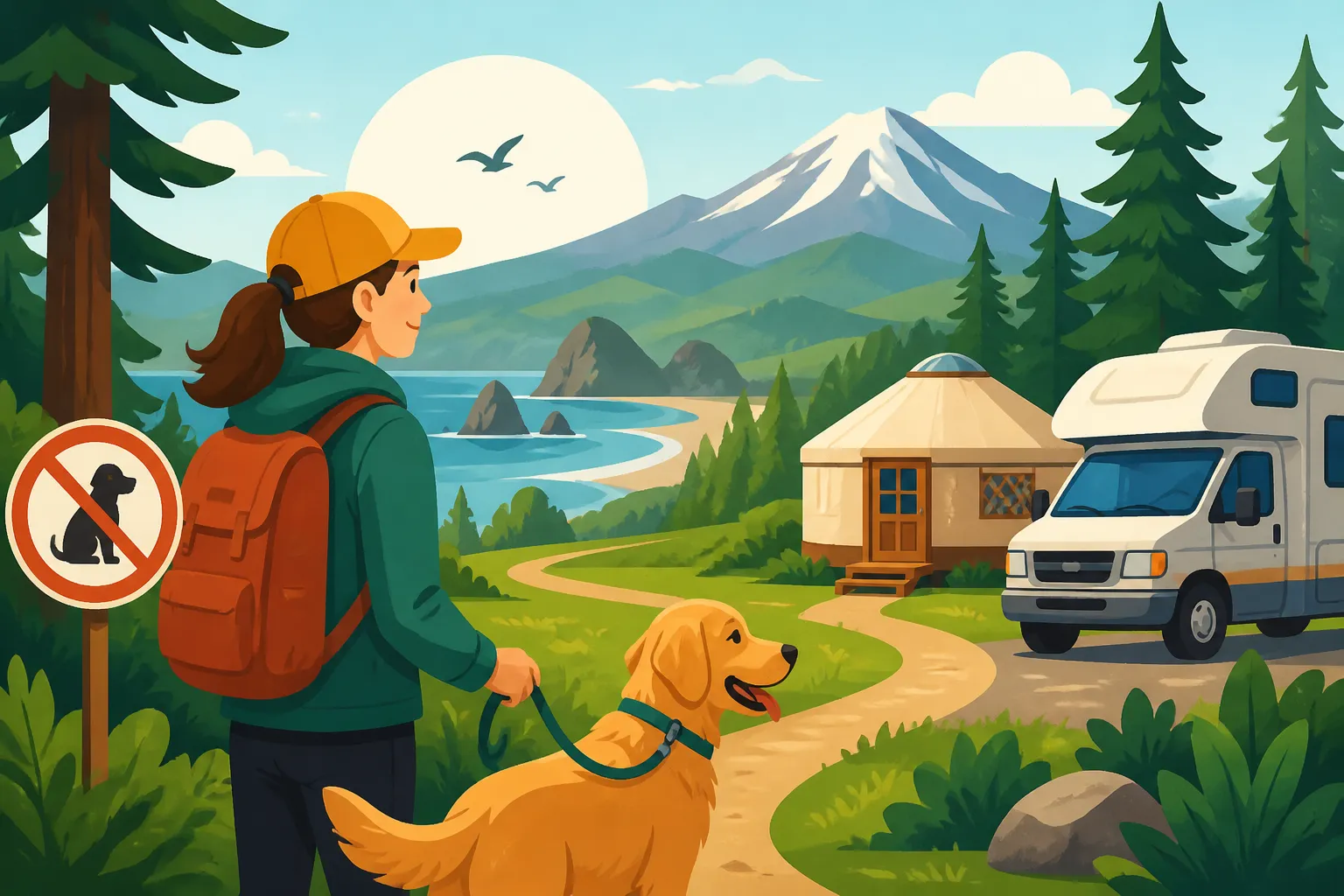
Pets in Oregon State Parks: Leash Rules, No-Dog Parks and Yurts
Bringing a dog to an Oregon state park takes more than packing a leash. A park may limit where pets can go, apply different rules to lodging, or restrict access in a particular area or season. The safest plan is to check the rules for the exact park, trail, beach and place you’ll sleep before you leave—and verify them again when you arrive.
Start With the Rules for the Exact Place You’re Visiting
There isn’t one assumption that works for every Oregon state park visit. Pet access can differ between parks and between areas within a park. A dog that is allowed at a campground, for example, may not be allowed in a garden, on a particular trail or in another restricted area. Access can also change with seasonal closures or updated park rules.
That makes the park’s official page the best starting point. Look for information about pets, leash requirements, restricted areas and seasonal notices. If you’re camping or staying in a yurt or cabin, check the accommodation listing as well. The park page describes the park; the lodging listing can answer questions specific to the unit or campsite.
The phrase “dogs allowed” is not enough to settle every practical question. It doesn’t necessarily tell you whether a dog can join you on every trail, enter every building or stay in the lodging you selected. Look for the rules that match your itinerary, rather than relying on a general summary or an old trip report.
Use a simple check before committing to a plan:
- Find the official page for the park you plan to visit.
- Read the pet information, including any areas where pets are not allowed.
- Check the details for your chosen campsite, yurt or cabin.
- Look for seasonal notices that affect the route or activity you want to do.
- If a restriction is unclear, use the official website to find current contact details and ask the park before arrival.
- Recheck official notices before you leave and when you get there.
For a broader overview of what can vary between locations, see Oregon State Park Rules That Change From Park to Park. If a park’s rules are difficult to find, Finding a Park’s Own Stay Rules on Its Oregon State Parks Page offers a useful way to locate the park-specific information rather than relying on a general answer.
| What you’re planning | What to confirm before the trip |
|---|---|
| Walking a trail with your dog | Whether pets are allowed on that specific trail and what leash requirements apply |
| Visiting a beach | Whether dogs are permitted in the area and whether a seasonal restriction is posted |
| Staying in a campsite | The park’s pet rules and any limits attached to the site or campground |
| Booking a yurt or cabin | Whether that exact unit accepts pets and what conditions apply |
| Visiting a garden or historic area | Whether pets are allowed in the particular attraction or grounds |
| Bringing a trained service animal | The applicable access rules, which can differ from pet rules |
The table is a planning prompt, not a substitute for the park’s current directions. When a detail matters to your trip, confirm it with the park’s official information.
Leash Rules and Good Trail Habits
A leash is a key part of planning a park outing with a dog, but don’t guess at the required length or assume the same rules apply everywhere. Check the leash requirement for the park and area you’ll visit. If a park specifies a particular leash length, use one that meets that requirement before you arrive. Also check whether the park has a designated area with different rules; don’t assume an exception applies beyond the specific place identified by the park.
Even where a dog is permitted, a controlled visit is easier for everyone. Keep your dog close enough to respond quickly to other visitors, wildlife and changing trail conditions. A short, secure leash can help you manage a narrow path, a busy viewpoint or a spot where people are passing in both directions. It also makes it easier to step aside without blocking the route.
Before setting out, consider how your dog behaves around other dogs, children, bikes and unfamiliar sounds. A dog that is calm at home may react differently in a crowded campground or beside a busy beach access. If your dog pulls, barks or becomes unsettled around other visitors, choose a quieter route or a less busy time, and keep the outing short enough that you can turn back comfortably.
A few habits make a big difference:
- Keep a hand on the leash when passing other visitors, especially on narrow paths.
- Give other dogs space rather than letting leashes tangle during greetings.
- Step off the path only where it is safe and permitted.
- Don’t allow your dog to chase, approach or disturb wildlife.
- Carry bags and clean up after your dog; pack waste out or use a designated disposal point where provided.
- Keep your dog from wandering into vegetation, water or other areas that are not part of the route.
- Check the trail surface and conditions before a long walk; heat, rough ground and steep terrain can be hard on a dog.
A dog’s manners are only one part of access. A trail can be difficult to share even with a well-behaved dog if it is narrow, steep, crowded or near a sensitive area. Build in a pause before busy pinch points and be ready to choose another route if the setting isn’t working.
Beach visits deserve their own check. Coastal access, wildlife protections and seasonal restrictions can affect where dogs may go. Don’t treat a long stretch of beach as one uninterrupted dog area. Review the official notice for the exact beach access you’re using, and follow any signs at the entrance. For more on coastal dog outings, see Seasonal Beach Closures to Dogs Near Oregon State Park Campgrounds and Beach Days With a Dog From a Coastal State Park Campground.
If you’re uncertain whether a path or access point allows dogs, don’t use “I saw another dog there” as confirmation. A visitor may be in a different zone, following an exception or ignoring a restriction. Check the current park information or ask park staff through the contact details on the official website.
No-Dog Parks and Restricted Areas
Some Oregon state park visits are not suitable for dogs because a park or a particular attraction has a no-dog restriction. Shore Acres State Park is associated with a no-dog rule, so verify the current restriction and its scope before planning a visit there with a pet. The exact boundary matters: a restriction may apply to the park, a feature within it or a defined area, and it should not be guessed from a short summary.
If a destination has a no-dog rule, the practical choice is to leave the dog at home or plan another outing where pets are allowed. Don’t count on leaving a dog in a vehicle while you visit. Conditions in a parked car can become dangerous, and some park areas may also have rules about pets left unattended. Confirm the applicable requirements instead of assuming that a vehicle solves the problem.
For an attraction-based outing, make a list of the places you actually want to visit, not just the park name. A park visit might include a campground, trail, garden, viewpoint and beach access, each with its own access conditions. Check each one separately if you expect to move between them.
A simple alternatives plan can prevent a last-minute scramble:
- Pick a dog-friendly stop for the person staying with the dog.
- Choose a different park or activity that fits the whole group.
- Split the outing only if the dog can be cared for safely and lawfully.
- Don’t enter a restricted area with the dog because the route looks open or other visitors are doing so.
Keep in mind that a general pet policy is not the same as permission to enter every feature of a park. If you’re visiting a garden, historic property, visitor facility or another named attraction, check that attraction’s rules directly. Shore Acres State Park Visits: Garden, Parking and No-Dog Rule can help you plan around the specific questions that come up at Shore Acres. For parks where dog access is more limited, Leave the Dog at Home: Three Oregon State Parks With Pet Bans is another relevant starting point, but confirm current details with the official park pages before you travel.
Service animals are not simply pets, and access rules can be different. If you’re traveling with a service animal, consult Service Animals and Pets at Oregon State Parks: Where Rules Differ and confirm any question about a particular facility or activity with the park. Don’t assume a pet restriction automatically answers a service-animal question, or that a pet exception applies to a service animal.
Camping With a Dog
A dog-friendly campground is only one part of a workable trip. Before booking, confirm the rules for the campground and the specific kind of site you want. Check whether the park has pet limits, restricted areas, leash requirements or conditions that affect where you can walk your dog. Also look at the campground layout: a site close to a main path, play area or busy gathering point may be less comfortable for a dog that needs space and quiet.
Plan your dog’s day around the campground, not just the destination trail. That means deciding where the dog can go when you need to use a facility or take part in an activity where pets aren’t allowed. Don’t assume that a dog can be left alone at a campsite or in a vehicle. Verify the rules, consider your dog’s comfort, and make an alternate plan if your itinerary includes time away from the campsite.
Bring the basics that let you follow the rules and keep the campsite tidy:
- A leash that meets the park’s stated requirement, plus a spare if you have one.
- Waste bags and a way to carry used bags until you reach an appropriate disposal point.
- Food and water containers that are stable and easy to clean.
- Familiar bedding or a mat, if your dog uses one.
- A light or reflective gear for moving around safely in low light, where appropriate.
- A copy of any booking details or pet-related instructions that apply to your site.
Avoid leaving pet food or waste where wildlife can reach it. Store food as directed by the park and follow any posted instructions for waste and campsite cleanliness. Keep your dog close, especially during quiet periods or when wildlife may be nearby. For broader campsite habits that help protect the setting, see Leave-No-Trace Habits for Oregon State Park Campsites and Elk and Deer Near Oregon State Park Campgrounds: Keeping Distance.
Think carefully about the length of the outing, too. A dog that is comfortable at camp may still struggle with a long, hot or steep walk. Bring enough water for the planned activity, allow breaks and turn around if your dog shows signs of fatigue or distress. If the route is exposed or the weather is uncomfortable, a shorter walk may be a better choice.
Be considerate of neighboring campers. Dogs can hear unfamiliar noises at night and may bark when people walk past. Keep your dog close to your site, avoid letting it roam between campsites, and follow the park’s quiet and pet rules. If your dog is uneasy in a crowded campground, a less busy park or a different kind of accommodation may be a better fit.
If you’re choosing a site partly because it seems convenient for dog walks, check the campground map and official descriptions before booking. A nearby path may have a pet restriction, or it may lead to an area with different rules. A map helps with layout, but it does not establish pet access by itself. Check both the map and the park’s written rules. Campground Maps and Site Photos: Picking a Spot Before You Book can help you evaluate the location, while Campground Rules at Oregon State Parks: Quiet, Vehicles, Fires covers other rules that shape a stay.
Yurts and Cabins: Confirm the Exact Unit
Do not assume that every yurt or cabin accepts pets just because the park allows dogs in some areas. Lodging rules may differ from campground rules, and pet-friendly units can be limited. Before booking, confirm that the exact unit is designated for pets and read the conditions attached to that unit. A general page about the park or lodging type may not answer every question about a specific reservation.
A useful checklist for a yurt or cabin listing includes:
- Does the listing identify the unit as pet-friendly?
- Are there pet-specific conditions or limits?
- Does the rule apply to the unit you selected, not just another unit at the park?
- Are there areas near the lodging where dogs are not allowed?
- What should you do if the pet designation or instructions are unclear?
If a booking page gives you a unit number or type, use those details when checking. Don’t rely on a map symbol or the fact that a different unit at the same park allows pets. If you have already booked a non-pet unit, don’t assume you can bring a dog anyway; check the park’s official information and contact the reservation provider or park using its current official contact details.
The pet-friendly lodging options may be limited, so flexibility helps. If your preferred yurt or cabin isn’t available for pets, consider a campsite, another park or a different date, provided those options suit your group. Keep the dog’s needs in mind as you compare: a compact indoor space, shared campground paths or a busy setting may not suit every animal.
Before arrival, read the full lodging instructions. Pay attention to where the dog may be, how it must be managed and what cleanup is expected. Bring the supplies your dog needs rather than assuming that the unit includes pet equipment. If the listing does not clearly answer a question, get confirmation before traveling.
The pet-specific articles below can help you narrow your search:
- Pet-Friendly Yurts and Cabins at Oregon State Parks: Rules, Limits
- Two Pets Max: Bringing Cats or Dogs to a State Park Cabin
- Beverly Beach State Park Yurts That Welcome Dogs
- Is Yurt Camping at Cape Lookout State Park Open to Pets?
These titles point to topics that may be useful, but the current official listing for the exact lodging is the final check. Pet designations and available units are not interchangeable across parks. For general differences between lodging types, see Cabins and Yurts at Oregon State Parks: Rustic, Deluxe, What to Bring and Yurt or Cabin? Picking Your Shelter at an Oregon State Park.
Planning the Trip Around Your Dog
A good pet-friendly itinerary is built around confirmed access, realistic travel time and a backup plan. Start by choosing the park and overnight option, then check whether the activities you want are actually open to dogs. If the dog can’t join one part of the plan, decide in advance what will happen rather than improvising in the parking lot.
A practical planning sequence looks like this:
- Choose the park. Start with the places you want to visit, then check their pet information before setting dates.
- Choose the overnight stay. Confirm whether the campsite, yurt or cabin allows pets and read its conditions.
- Build an activity list. Check each trail, beach, garden or attraction individually.
- Plan the dog’s routine. Include water, rest, exercise and a safe way to manage time when the dog can’t join an activity.
- Prepare for restrictions. Identify a second route or alternate park in case a seasonal notice or posted rule changes your plan.
- Recheck before departure. Look at official notices for the park and the specific area you intend to visit.
- Check signs on arrival. Follow posted directions, even if an older webpage or a previous visit suggested something different.
A backup plan is especially useful on the coast. Weather, access conditions and seasonal wildlife protections can affect which areas are appropriate for a dog. If your main plan depends on a particular beach or trail, identify a second option before you go. Coastal State Parks Open to Day Visitors Through the Winter and Rainy Season at Coastal Oregon State Parks: Yurt or Tent? can help with broader seasonal planning, but neither replaces checking pet access at the exact location.
Travel days also need attention. Give your dog a chance to drink, stretch and settle before arriving at a busy campground. Have the leash and waste bags easy to reach instead of buried in packed gear. If you expect to reach camp after dark, plan how you’ll unload and settle the dog without disrupting neighboring campers. Late Arrival at an Oregon State Park Campground After Dark offers additional arrival-planning help.
If you’re traveling with a cat rather than a dog, don’t assume dog guidance covers every situation. Check the park and lodging rules for the animal you’re bringing, and read Camping With a Cat at an Oregon State Park: Leash and Cabin Rules for related considerations.
The best plan is not necessarily the one with the most activities. It’s the one where you know where your dog is allowed, have a suitable place to stay and can adjust if access is more limited than expected. Confirming those details ahead of time is easier than trying to solve them after you arrive.
Frequently Asked Questions
Are dogs allowed in Oregon state parks?
Dog access varies by park and by area within a park. Check the official page for the park and the rules for each trail, beach, attraction or lodging option you plan to use.
Do dogs have to be on a leash?
Check the leash requirement for the specific park and area. Don’t assume a particular leash length or an exception applies everywhere; follow the current official directions and posted signs.
Can I bring my dog to a state park yurt or cabin?
Only if the exact unit and its current listing allow pets. Confirm the designation and conditions before booking or arriving.
Can I take my dog to Shore Acres State Park?
Shore Acres is associated with a no-dog rule. Check the official park information for the restriction’s current scope before planning a visit with a pet.
What should I do if a park’s pet rules are unclear?
Check the park’s official website for current information and contact details. Ask about the exact area, activity or lodging unit you plan to use, then follow any posted directions when you arrive.
Disclaimer
This article is for general informational purposes only and does not constitute professional advice. Laws, prices and regulations vary by location and change over time. Consult a qualified professional for guidance on your specific situation. Oregon Camping & RV is not a government agency and is not affiliated with any government agency.
